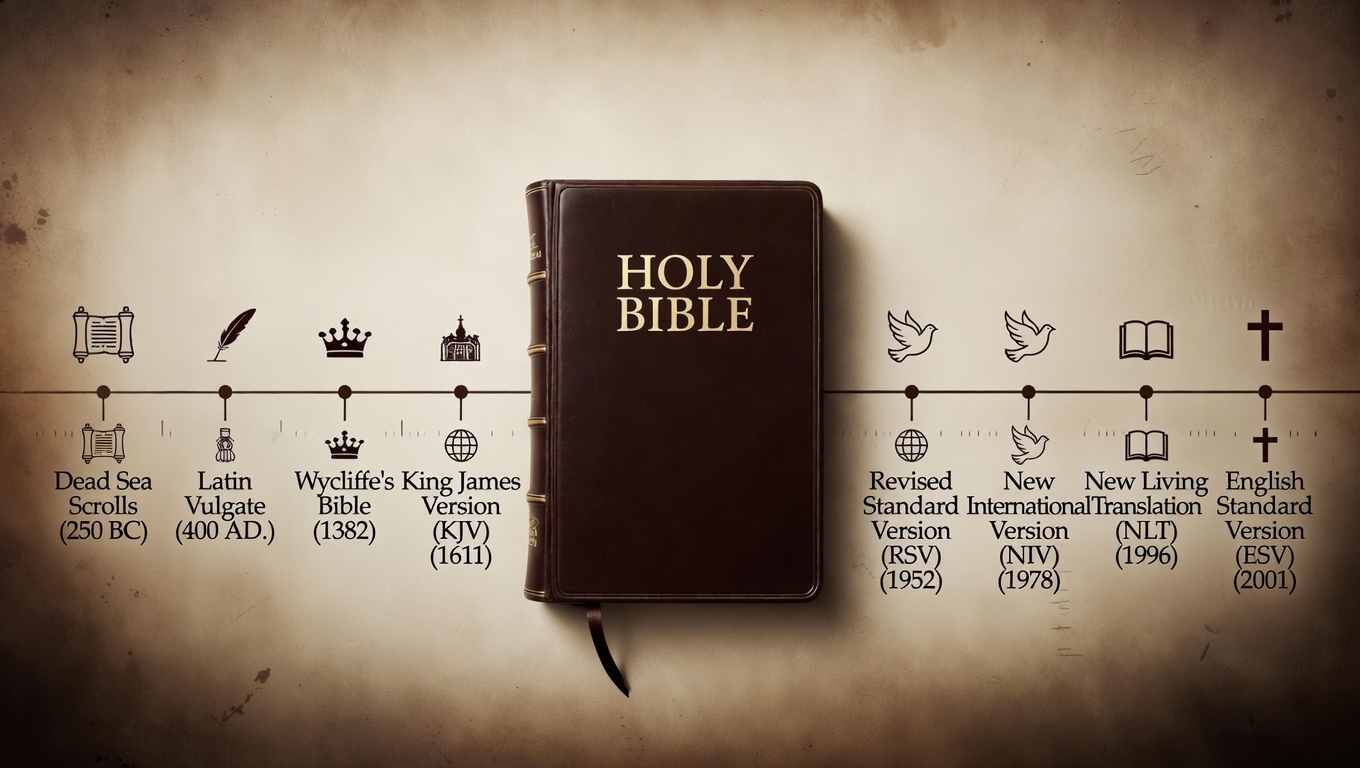
Most people have never thought about where the Bible actually came from. It wasn’t handed down from heaven in a leather binding with gold letters. It was written over more than a thousand years, translated across multiple languages, copied by hand for centuries, nearly destroyed multiple times, and fought over by kings, popes, and scholars.
That history matters. Understanding how the Bible was preserved — and what it cost the people who preserved it — changes how you read it.
Why were there so many translations?
Because language changes over time. In the U.S. people certainly don’t speak the King’s English anymore. People don’t speak Latin anymore either. There is great demand now for Spanish and other languages too as the Gospel spreads around the world.
Can we trust the people who wrote these translations?
Imagine you are born the Jewish son of one of the keepers of an Old Testament scroll like Jeremiah. It has been passed down all the way to your father for hundreds of years. there is no Bible, printing press or copy machines yet. Your father is getting up in years. He needs you to make copies to pass down to the next generations. You had to write every bit of it by hand and you have enough respect for the word of God that you don’t want to dare make a mistake. Day and night for you whole life you look at the version your father gave you and make by hand an exact copy. One copy after another until your eyesight failed you and you handed the duty off to your son. If this were you, how careful would you be to make it perfect?
How do I start reading the Bible?
Timeline
The timeline below traces that history from the first Greek translations of the Old Testament all the way to the modern versions on your phone today.
The primary source for this timeline is The Origin of the Bible by Philip Comfort (2003).
| Date | Event |
|---|---|
| 300 B.C. | The Septuagint Pentateuch was written. It is the oldest written Greek version of the Pentateuch. The Jews living in Egypt spoke Greek, so there was great demand for a translation from Hebrew to Greek. The rest of the Old Testament was written by various scholars over a long period of time. The Septuagint was used by the New Testament authors when quoting the Old Testament. Most people around the time of Christ spoke Aramaic or Greek, not Hebrew. |
| 400 A.D. | Jerome converts the Greek and Hebrew texts into the Latin Vulgate, which is used by the Roman Catholic church. |
| 500s | Missionaries bring the Latin Bible to England where monks read it aloud for centuries. |
| 1008 | Best known (Codex Leningradensis) Masoretic text of complete Old Testament is copied by the Ben Asher family. This text will be used by all future versions of the Bible. Despite how old these texts were, they were still written from one to two thousand years after the original autographs of the Old Testament. |
| 1382 | John Wycliffe (unfamiliar with the original Hebrew and Greek texts) converted the entire Latin text into English — a translation of a translation — against the wishes of the Pope. Several decades after he died, the Catholics dug up his body, burned it, and threw his ashes into a river. His associate John Purvey revised it in 1388. |
| By 1500 | Scholars at Oxford were beginning to read the New Testament in its original Greek as a resurgence of Greek occurred during the Renaissance. Between 500–1500 A.D., Latin had been the dominant language used by scholars. |
| 1516 | First Greek language New Testament printed on a printing press by Erasmus. Known as the Textus Receptus. He used eight late manuscripts dating from the 10th–13th centuries. He was missing the last six verses of Revelation, which he took from the Latin text. It was rushed and had typographical errors. |
| 1525 | While living in Germany, William Tyndale completes his translation of the Greek New Testament into English, making 15,000 copies. Germany flooded England with copies while the Catholic church banned his version and tried to confiscate and burn them. His final revision was in 1535. He was captured and burned at the stake by order of Henry VIII in 1536. |
| 1535 | Miles Coverdale produces the first complete printed English Bible, drawing heavily on Tyndale’s work. |
| 1560 | The Geneva Bible is produced by English Protestant exiles in Geneva. It was the first English Bible to use verse numbers and became the Bible of choice for English Protestants, including the Pilgrims who brought it to America. |
| 1611 | King James I commissioned 50 scholars to produce a new English translation. Completed in 1611, the King James Version (KJV) used the Hebrew Masoretic Text and the Greek Textus Receptus. It became the dominant English Bible for over 300 years and is still called The Authorized Version in England. Minor revisions corrected printing errors over the years, with the final version settling in 1769. |
| 1800s | Three significant early Greek manuscripts are discovered: Codex Sinaiticus, Codex Vaticanus, and Codex Alexandrinus — all dated between 325–450 A.D. These older manuscripts would eventually become the foundation for the Nestle-Aland Greek New Testament text used by most modern Bible translations. |
| 1901 | The American Standard Version (ASV) is published as a revision of the KJV using more accurate source texts. It became the foundation for several later translations. |
| 1947–1956 | The Dead Sea Scrolls are discovered in caves near Qumran. Written between 300 B.C. and 100 A.D., they are the oldest known Hebrew manuscripts of the Old Testament and largely confirm the accuracy of the Masoretic Text used by modern translations. |
| 1952 | The Revised Standard Version (RSV) is published as a revision of the ASV. It used older and more reliable Greek manuscripts than the KJV. |
| 1971 | The New American Standard Bible (NASB) was produced by The Lockman Foundation to update the American Standard Version. 32 scholars used formal equivalence, aiming for literal accuracy in a more readable style. It is praised as a good study Bible but criticized as not being truly modern. It tends to follow the Textus Receptus, putting it 30+ years behind in New Testament text scholarship. |
| 1976 | The Good News Bible (Today’s English Version) was published by The American Bible Society. It only contained the New Testament from 1966–1976 and sold 35 million copies within the first six years. It was criticized as too interpretive. |
| 1978 | The New International Version (NIV) was published by Zondervan as a thought-for-thought translation. Since 1987 it has outsold the King James Version. The goal was a Bible somewhere between the literal accuracy of the American Standard Bible and the loose paraphrasing of The Living Bible. |
| 1982 | The New King James Version (NKJV) was a revision of the KJV maintaining a literal approach to translation. Its authors used the Textus Receptus rather than the Majority Text or Nestle-Aland text — accounting for 1,000+ differences. Elizabethan language was updated to modern English, though sentence structure remained the same. Notes were provided on textual differences. |
| 1986 | The New Jerusalem Bible revised the Jerusalem Bible of 1966 using more recent sources. It has been considered a good study text, though the New Testament contains some unique Western readings. |
| 1989 | The Revised English Bible was a revision of the New English Bible (1971), updated for more modern language. It used the Masoretic text, Dead Sea Scrolls, and the NA 26th edition. |
| 1989 | The New Revised Standard Version (NRSV) was published in three versions: basic, with Apocrypha, and Catholic. It is the official pew Bible of Methodist churches. It uses the Dead Sea Scrolls alongside the Masoretic text and follows the most up-to-date Nestle-Aland/UBS New Testament text. It uses more gender-neutral language. |
| 1996 | The New Living Translation (NLT) was published by Tyndale House. A second edition followed in 2004. It uses dynamic equivalence and is one of the most readable English translations available. |
| 2001 | The English Standard Version (ESV) was published using the Masoretic Hebrew text and the 1993 Nestle-Aland/UBS Greek New Testament. It uses essentially literal translation — word-for-word where possible, shifting to dynamic equivalence only when necessary. It is widely regarded as a strong study Bible that reads more naturally than the KJV. |